Your Website May Look Great. But If Search Engines Cannot Understand It, Your Customers May Never Find It.
You may have a great-looking website, great services, and great content, but none of that matters if your audience cannot find you on Google.
That’s where Search Engine Optimization, or SEO, comes in. SEO helps search engines understand your website and helps potential customers find your business when they are searching for relevant products, services, or information.
However, a lot of businesses will spend money on websites and content and ignore the basics that actually drive search visibility.
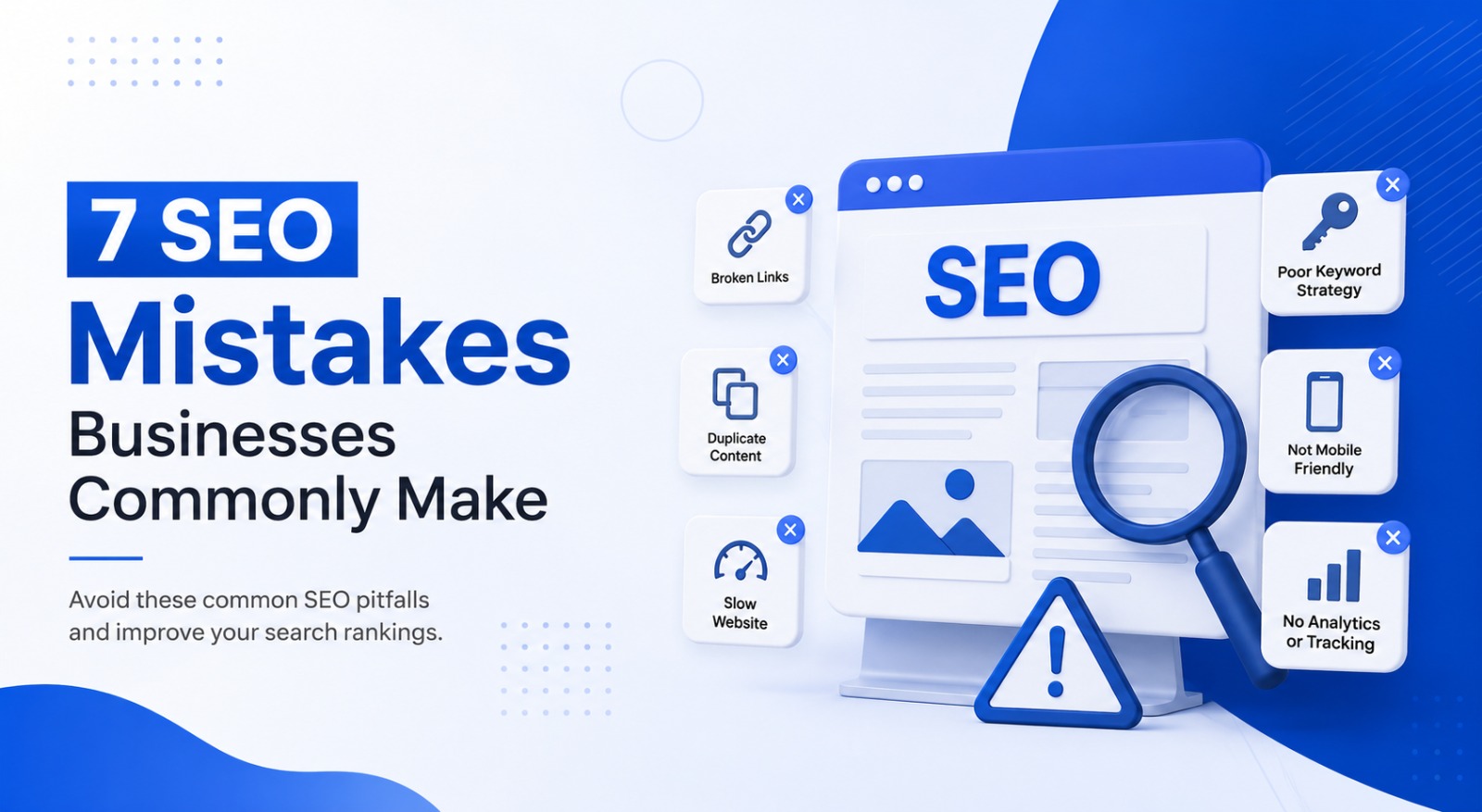
7 Common SEO Mistakes Businesses Make
1. Targeting the Wrong Keywords
Choosing keywords solely on search volume is one of the biggest SEO mistakes. A keyword may have thousands of searches, but if the people searching for it are not your potential customers, it will bring very little value.
For example, a business providing professional IT recruitment may target a broad keyword like “jobs” when a more relevant keyword could be “IT recruitment services.”
The best way is to consider: Search intention Business relevance Contest Customer requirements Commercial value
It is not to bring more visitors. The aim is to draw the right visitors.
2. Publishing Content Without a Clear Search Intent
Just because you create regular blog posts doesn’t automatically mean better SEO. Every piece of content should have a specific question it answers, or a specific problem it solves for your target audience.
Before creating content, ask yourself:
What is the user searching for? What do they want to know? What is the next step after reading?
If a page doesn’t match search intent, users may bounce quickly, and the content might be unable to rank in search results. Good seo content is useful, relevant, clear, and written for real people first.
3. Ignoring On-Page SEO
Even great content can bomb if you’re ignoring the basics of on-page SEO.
Some key parts are:
Meta description, page heading structure, outline, URL structure, keyword placement, internal links, relevant and useful information, image credits.
These things tell search engines what a page is about. They also help users determine if a search result is relevant to the user. SEO isn't all about writing more. It is about better structuring of information.
4. Having a Slow or Poorly Designed Website
Website performance impacts users and search visibility. If a website takes too long to load, users might leave before they even see the content.
Businesses should take note of: Page Load Times Mobile usability Size of image Website navigation Stability of layout Overall experience of users
A website should be easy for visitors to navigate, understand the offer, and take action.
A website that makes users wait makes your business wait too.
5. Forgetting Mobile Users Most audiences now discover businesses on multiple devices, including smartphones. A website that looks nice on a desktop but feels hard to use on a mobile screen can make for a bad experience.
Check if: Text is easy to read
Buttons are easy to tap
Images fit the screen
Navigation is simple
Forms work properly
Pages load efficiently
Mobile usability should not be an optional feature. Your website should work wherever your customer is looking.
6. Neglecting Internal Linking
While internal links are often overlooked, they can make a website easier to navigate and help search engines find related pages.
For example, an IT staffing blog might naturally link to articles on:
IT recruitment, contract-to-hire jobs, talent solutions, temporary employment, and recruitment services. This link is to related content that helps users find more useful information. Your website is a connected system of information, not a collection of separate pieces of content.
7. Expecting SEO Results Overnight SEO is not an overnight marketing channel. Sometimes businesses publish a few articles, make a few changes to their website, and expect immediate rankings.
Getting visibility in search engines usually takes consistent effort on:
Content + Technical SEO + User Experience + Authority + Consistency
The results may differ depending on the competition, the history of the site, the niche, the quality of the content, and many other things. The biggest mistake is giving up on SEO before the strategy has had enough time and consistent effort to produce meaningful results.
SEO is not a quick fix. “It’s a long-term investment in searchability.”
How to Avoid These SEO Mistakes
A strong SEO strategy starts with the basics.
Step 1: Understand Your Audience
Figure out what your customers search for, what problems they have, and what information they need before deciding.
Step 2. Create A Keyword Plan
Don’t pick keywords by volume; pick them by search intent and relevance.
Step 3: Create Quality Content
Ask real questions and give your audience real information that will be useful to them.
Step 4: Make your website more efficient
Fine-tune page titles, header tags, URL’s, internal links, images, mobile usability, and site speed.
Step 5: Measure Performance
Track key metrics like organic traffic, search visibility, engagement, leads, and conversions.
Step 6: Keep Improving
SEO is a process and never stagnant. Search behavior, your competitors, your content, and the search engine systems are always changing.
The Bottom Line
SEO is not writing hundreds of articles or stuffing keywords all over the place. It's about making your site useful for people and findable by search engines.
Businesses that rank well in search are generally the ones that consistently focus on:
Related things. Good website performance. Intuitive user experience. Search intent. Continuous optimization
So before you ask: “Why won’t my website rank?” Ask:
“Is my website providing search engines and customers a clear reason to choose it?”
Better website, better rankings. Don't just try to rank higher. Create a website that is worth finding.