AI Automation vs AI Agents: What Is the Difference for Businesses?
VCentrix Admin
Author
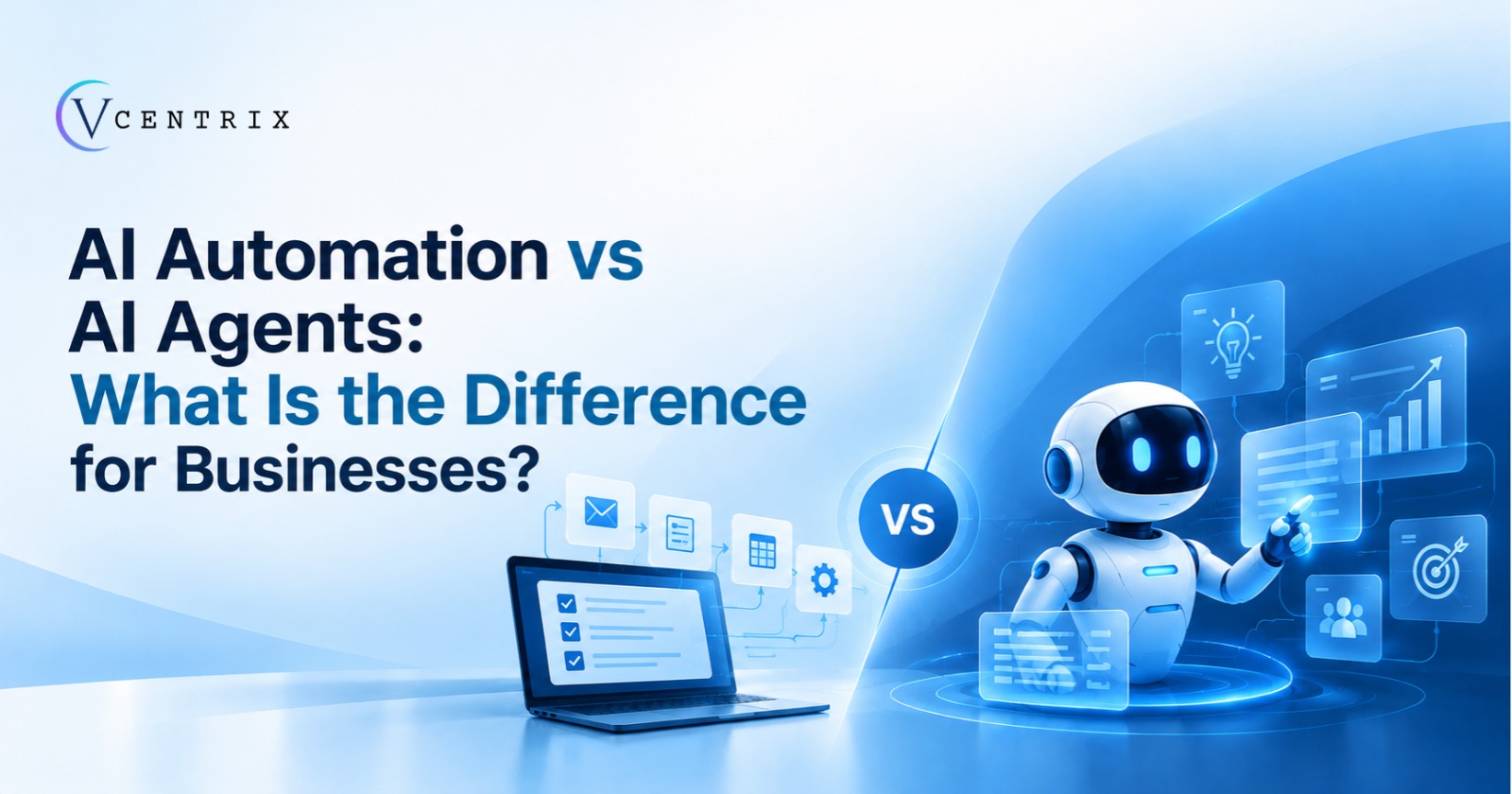
"AI automation" and "AI agents" are often used as if they mean the same thing. They don't. Both can save your team time and money, but they work very differently, and choosing the wrong one can waste budget or deliver disappointing results.
This guide explains the difference in plain language, shows where each one fits in a business, and helps you decide where to start.
What Is AI Automation?
AI automation uses software and AI models to carry out a defined task or workflow. You design the steps in advance, and the system follows them every time. Think of it as a very reliable assembly line.
Common examples:
Sending an invoice reminder when a payment is 7 days overdue
Sorting incoming support emails into categories
Extracting data from forms or PDFs and entering it into a CRM
Generating a weekly report from your sales data
AI automation works best when the process is repeatable, predictable, and rule-based. The AI may add intelligence to a step, such as reading a document or classifying a message, but the overall path is fixed.
What Are AI Agents?
An AI agent is a system that is given a goal rather than a script. It decides what steps to take, chooses which tools to use, checks its own progress, and adjusts when something unexpected happens. Think of it as a capable team member who can figure out how to get a job done.
Common examples:
A support agent that reads a customer's issue, checks order history, issues a refund within set limits, and writes a personal reply
A research agent that gathers market data from several sources, compares it, and drafts a summary
A sales agent that qualifies leads, books meetings, and updates your CRM
An IT agent that investigates an alert, tests likely causes, and proposes a fix
AI agents work best when the task is variable, multi-step, and needs judgment.
The Key Differences at a Glance
AI Automation | AI Agents | |
Input | Defined steps and rules | A goal to achieve |
Decision-making | Follows a fixed path | Chooses its own path |
Handling surprises | Stops or escalates | Adapts and tries alternatives |
Predictability | Very high | Moderate, needs guardrails |
Setup effort | Lower | Higher |
Best for | Repetitive, structured work | Complex, changing work |
Risk level | Low | Higher, needs oversight |
When Should a Business Choose AI Automation?
Choose automation when:
The process rarely changes, and the steps are clear
Accuracy and consistency matter more than flexibility
You need an audit trail that is easy to explain
The volume is high, and the cost per task must stay very low
Payroll processing, data entry, scheduled reporting, and standard approvals are strong candidates. Automation is often the fastest return on investment because it is simple to build and easy to measure.
When Should a Business Choose AI Agents?
Choose agents when:
Each case is different and rigid rules would break
The work involves several tools, systems, or sources of information
A human currently spends time reading, thinking, and deciding
You want to handle exceptions without constant manual intervention
Customer support triage, research, lead qualification, content operations, and technical troubleshooting are common fits.
Why Most Businesses Need Both
This is not an either-or choice. The strongest setups combine the two. Automation handles the predictable backbone of the process, and agents take over the steps that need reasoning.
For example, an automated workflow can receive a customer complaint, log it, and route it. An AI agent then investigates the issue and drafts a resolution. Automation completes the follow-up, such as updating the ticket and sending the confirmation.
Risks to Plan For With AI Agents
Because agents make their own decisions, they need more care than simple automation.
Set clear limits. Define what the agent can and cannot do, such as refund caps or approval thresholds.
Keep humans in the loop. Require review for high-value or sensitive actions.
Log everything. Record decisions and actions so you can audit and improve them.
Protect your data. Give agents access only to the systems and information they need.
Test before scaling. Start with a small, low-risk use case and measure results.
How to Get Started
Map your processes. List the tasks your team repeats most often.
Sort them. Mark each as rule-based (automation) or judgment-based (agent).
Start small. Pick one high-impact, low-risk process and run a pilot.
Measure the outcome. Track time saved, error rates, cost, and customer satisfaction.
Expand step by step. Add more workflows and agents once the first one proves its value.
AI automation is about doing known tasks faster and more reliably. AI agents are about handling goals that need thinking, adapting, and decision-making. Understanding the difference helps you invest in the right tool for the right job, and avoid paying for complexity you don't need.
The businesses that benefit most are not the ones that adopt the newest technology first. They are the ones that match the technology to the problem.
Not sure where AI automation or AI agents fit in your business? Talk to our team, and we will help you identify the best opportunities to start.